


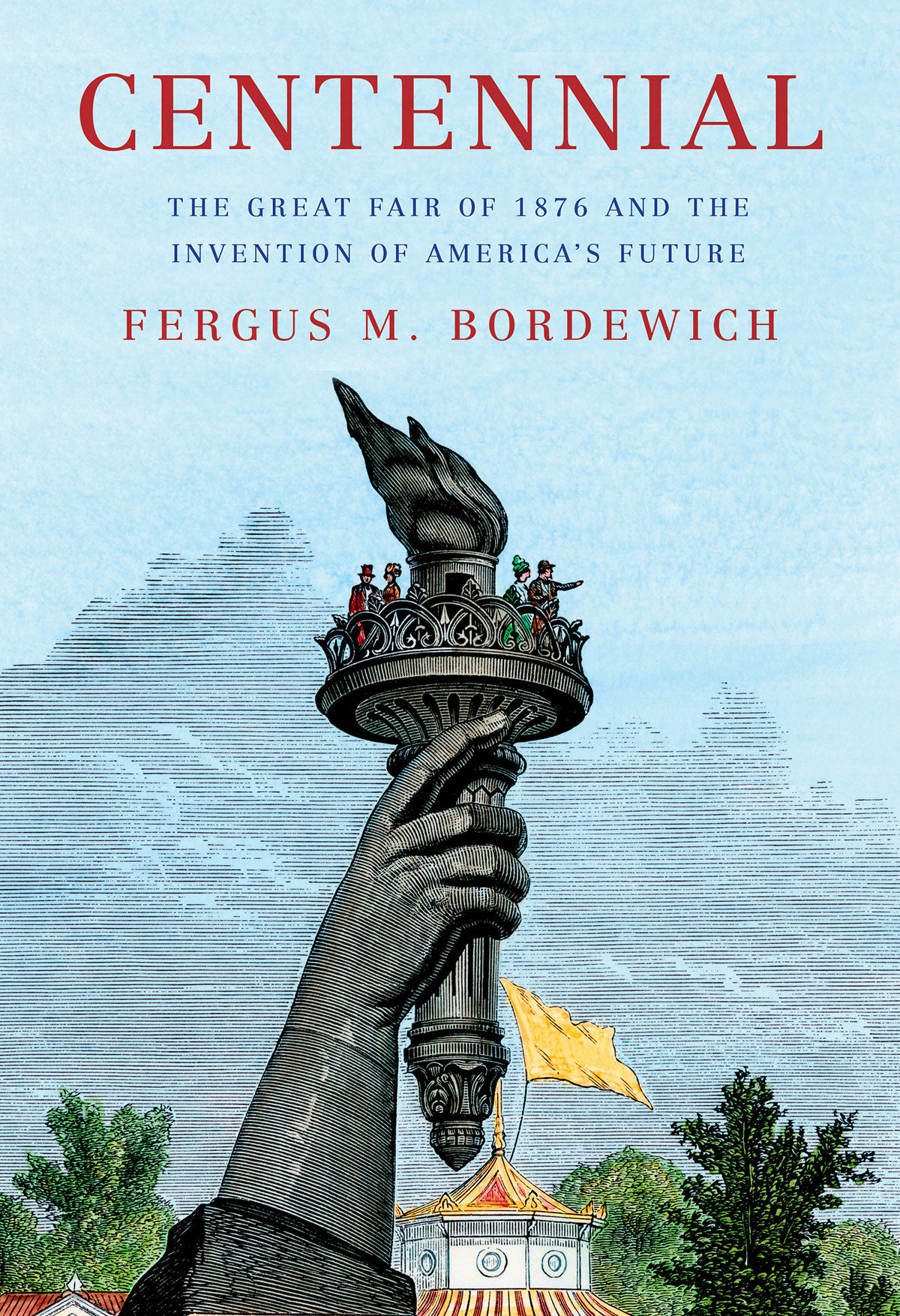
ORDER THE NEW BOOK:
CENTENNIAL: The Great Fair of 1876 and the Invention of America’s FutureASIDE
A book may emerge from almost anywhere. In my last, Klan War, I wrote about the remarkable and courageous Major Lewis Merrill, who faced down the Ku Klux Klan in South Carolina. I noticed that he later served as an aide to the director of the Centennial Exhibition of 1876, in Philadelphia. I then knew little about the Great Fair, as it was often called. Intrigued, I decided to learn more. I found out almost nothing about Merrill’s activities there, but in the process of searching I discovered the spectacular cultural extravaganza that was America’s first World’s Fair. There, not only did Americans see a dazzling cornucopia of new inventions—the telephone, the typewriter, even root beer—but they also encountered for the first time the tantalizing glamor of European and Asian civilizations. I realized that the fair offered an extraordinary window into life in the centennial year, when Americans were consciously evaluating the meaning of the nation’s first century. It revealed - both deliberately and often not—much about the post-Civil War era, and about Americans’ dreams of greatness for the future. At the same time, it also avoided facing up squarely to the multiplying crises that threatened to transform the very nation that Americans celebrated: racial strife in the South, deepening labor conflict, renewed Indian war, and the watershed presidential election of that year, all of which would shape the America to come in the 20th century.
I never did find a way to weave Major Merrill into Centennial. His duties most likely involved only unglamorous staff work, no doubt a welcome reprieve after his years entangled in the bloody civil strife in the South. He soon returned to active duty in the frontier West. However, he had led me to a panoramic view of the turbulent America of his time that lay beyond the shimmering surface of greatest show of the Gilded Age.
Praise for Centennial: The Great Fair of 1876
and the Invention of America’s Future
CENTENNIAL PRESS RELEASE | REVIEWS/INTERVIEWS | CENTENNIAL EXCERPT | ESSAY: WHAT CAN WE LEARN FROM AMERICA'S CENTENNIAL?
“Those who were there felt that the wheel of history itself
had turned before their eyes.”
Centennial tells the spectacular story of the Great Centennial Exhibition of 1876, a world’s fair to mark the nation’s hundredth birthday—and a moment of reckoning as the country barrelled through the Gilded Age. The Great Fair attracted more than 10 million Americans—nearly 20 percent of the population. Among them were Walt Whitman, P.T. Barnum, Frederick Douglass, and the Emperor of Brazil, along with visiors from all over the world. This celebration of America’s past and future came at a moment when the reality of life for countless Americans was precarious, as ordinary folks struggled to recover from the effects of devastating economic depression and the aftermath of the Civil War, as big money threatened to overwhelm the government, embittered workers waged the first national labor strike, feminists demanded rights for women, Native tribes fought to repel advancing settlement in the West, and Black Americans risked their lives to exercise their newly-won freedoms. Looming over the fair was the presidential election of 1876, one of the most hotly contested in American history: it would determine the fate of Reconstruction and permanently reshape the Republican party. Centennial animates these converging crises through the lives of four protagonists—the president-to-be Rutherford B. Hayes, the inventor Alexander Graham Bell, railroad magnate Tom Scott, and the African-American sculptor Edmonia Lewis—revealing a country striving to live up to the promise of the founders while bracing for the tidal wave of the twentieth century.
Reviews
“Brisk and tightly constructed, filled with vivid characters and finely wrought, often-wrenching scenes . . . Bordewich finds a country caught between the marvel of its material progress and the fragility of its ideals and institutions . . . Though we’ll mostly be looking back at 1776 this year, Bordewich has done a great service in calling our attention to 1876.” —Jake Lundberg, The Atlantic
“In his compelling Centennial, the historian Fergus Bordewich makes the stakes of the moment clear [and] brings the reader into the heart of the exhibition.” —Amanda Brickell Bellows, The Wall Street Journal
“As exuberant and immersive as the U. S. centennial itself, Fergus Bordewich’s bracing narrative envelops us in the optimism, patriotic fervor, overweening pride, and limitless ambition of 1876 America. With reunion and peace, the country celebrated itself with inventive abandon, sometimes forsaking its democratic roots. Fergus Bordewich brings his customary, irresistible blend of rich period detail and expert retrospective analysis to a story that should give us both pleasure and pause as we mark America250. A rich and rewarding read.” —Harold Holzer, Winner of the Lincoln Prize and author of Brought Forth on This Continent
“Bordewich’s Centennial immerses us in the wondrous Philadelphia exposition of 1876 with all its patriotic fervor, dynamic displays of industrial might, amazing inventions (the proto-telephone), silly gadgets (the combo suitcase/bathtub), and ambitious art. Outside the fair, the intense societal battles to shape this ascendant Gilded Age America feel at times eerily familiar: electoral convulsions amidst a ‘rancorous political climate,’ an ‘odious oligarchy with its plutocratic privilege,’ and rising White Supremacy targeting Blacks and immigrants. And yet . . . the nation’s most democratic ideals are there, too, as America barrels towards the twentieth century.” —Jill Jonnes, author of Empires of Light
“In Centennial, Fergus Bordewich transports us to the dazzling spectacle of the 1876 Centennial Exhibition at Philadelphia, where the sights, sounds, and flavors of a rapidly industrializing nation burst vividly into life. Millions of Americans encountered marvels they had never imagined—from typewriters to telephones, Turkish cafes to Chinese delicacies—revealing a country awakening to the wider world. Yet the country was unraveling in 1876, too. Corporate vigilantes were assassinating their labor union enemies, southern white terrorists were massacring innocent Blacks, and politicians were seizing on disputed election results to fan the flames of constitutional crisis. With cinematic sweep and piercing analysis, Bordewich’s Centennial captures both America’s glittering successes and bitter failures at the tail end of the nineteenth century. The story of the Gilded Age has never been told better.” —Zaakir Tameez, Winner of the Cooley Prize and author of Charles Sumner: Conscience of a Nation
“In 1876 the USA threw a spectacular 100th birthday party for itself—the Centennial Exposition in Philadelphia—and Fergus Bordewich is our astute guide and witty companion for an immersive tour. Bursting with delicious details and deft portraits, Centennial introduces us to the industrial titans, genius tech inventors, political strivers, artists, poseurs and protestors who made the fair an international sensation. Bordewich excels in charting the political and racial turbulence just below the glossy surface, and drills deep into the layers of pride and patriotism, hope and hubris animating the whole enterprise. As the nation marks its 250th birthday in 2026, unfolding in another fraught political moment, Centennial reminds us to pay attention to how this milestone is celebrated, how our history is portrayed and our future imagined. Beyond the hoopla and fireworks will be a reflection of our national character.” —Elaine Weiss, author of Spell Freedom and The Woman’s Hour
“With this piercing history of the 1876 Centennial, Fergus Bordewich illustrates the genesis of American exceptionalism and creates a cautionary parable for the Age of Trump. Every chapter dramatizes the gaps between our leaders’ self-congratulatory claims and their flawed, corrupt performance throughout our history.” —Howell Raines, author of Silent Cavalry
“American history fans will appreciate this timely, probing analysis of our past, for as America approaches its 250th birthday, we also look optimistically forward and back.” —Karen Clements, Booklist